
The program is intended to provide entry-level employment opportunities in the Nursing Assistant field.
Total Clock Hours
160
Number of Weeks
10
Program Delivery
Residential
Type of Instruction
Lecture, Lab, and Externship
Leads to the Standard Occupational Classification
31-1131 Nursing Assistants
Prerequisites
-
Proof of good health: A report includes a medical history, physical examination, and PPD Test or CXR signed by a healthcare provider performing the physical examination shall be provided to the institution indicating that the student does not have any health conditions that would create a hazard to him/her and patients or visitors. Due before clinical training begins. -
Must be free from conviction by any court (other than minor traffic convictions) or have clearance from the California Department of Health Services. -
Submit completed Live scan form before clinical training begins. -
Must be able to exert 20-50 lbs. of force occasionally, 10-25 lbs. of force frequently, or up to 10 lbs. of force constantly to move objects. -
Must be able to exert 20-50 lbs. of force occasionally, 10-25 lbs. of force frequently, or up to 10 lbs. of force constantly to move objects.
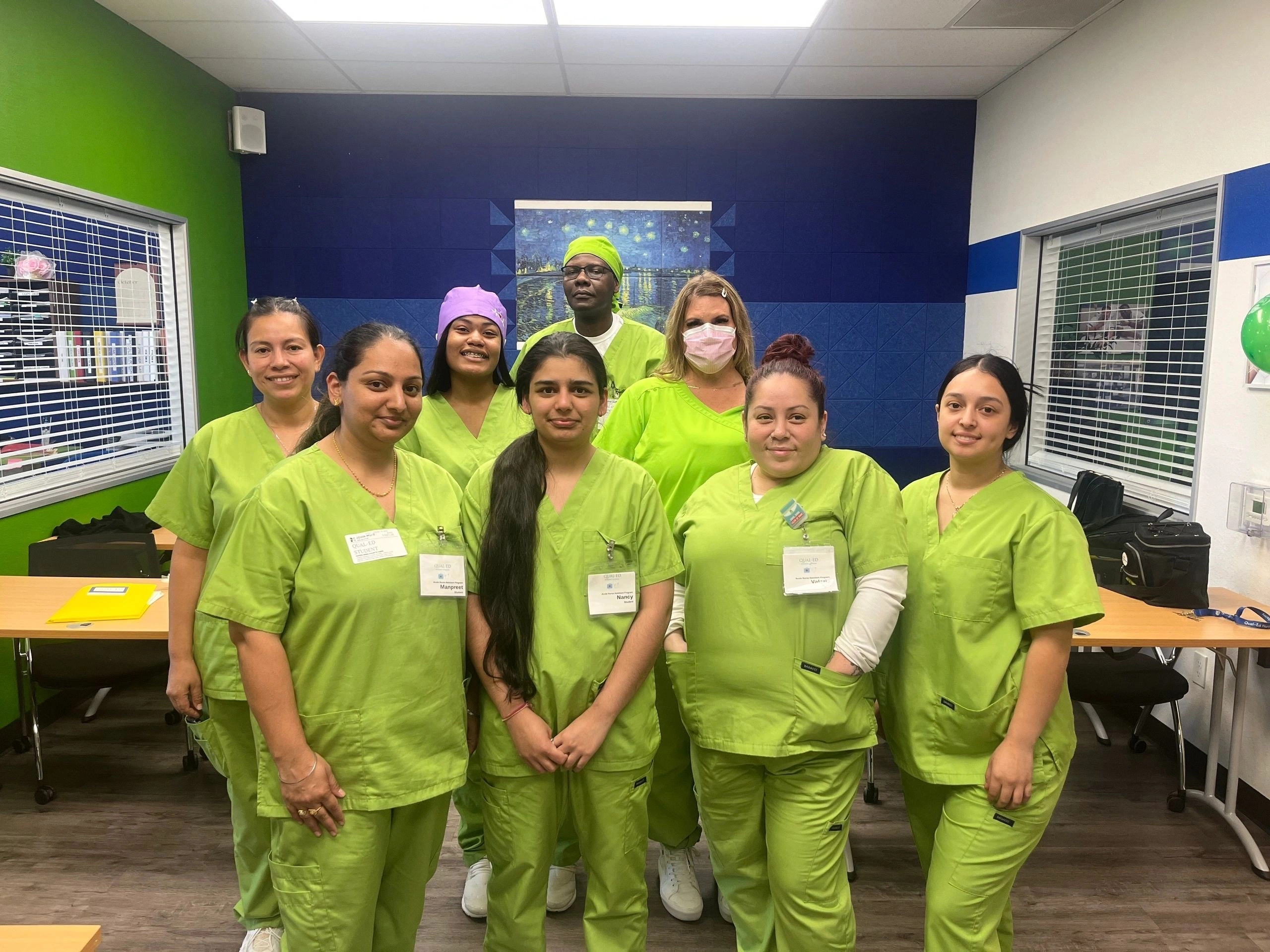
Program Goals and Objectives
The program is intended to provide entry-level employment opportunities in the Nursing Assistant field.
This program introduces the student to a nursing assistant with basic skills and competencies. Theory classes are held in the classroom, and clinical hours will be at the contracted training facilities or laboratory.
Prepares the Nurse Assistant Student for the California Nursing Assistant Competency Evaluation. Certification is after satisfactory completion of the program and passing the California State Exam. This course introduces the students to the role of a nursing assistant with instruction in basic skills and competencies. Theory classes will be held in the classroom, and clinical hours will be at the contracted training facilities or laboratory.
Upon completion of this program, the student will be able to:

-
Demonstrate application of basic math and science skills. -
Use verbal and written communication. -
Demonstrate legal and ethical responsibilities. -
Provide emergency care as well as personal patient care. -
Describe the anatomy and physiology of the human body. -
Perform physical comfort and safety functions and nursing procedures. -
Apply principles of nutrition and the principles of infection control. -
Provide biological, psychological, and social support. -
Perform organizational skills, following the patient plan of care. -
Assist with restorative (rehabilitative) activities. -
Demonstrate employability skills. -
Demonstrate knowledge of blood-borne diseases, including AIDS.
Course Outline
| Course Number | Course Title | Lecture | Lab | Clock |
|---|---|---|---|---|
| NA 101 | Introductions to Healthcare | 2 | 00 | 2 |
| NA 102 | Patients’ Rights | 2 | 1 | 3 |
| NA 103 | Interpersonal Skills | 2 | 00 | 2 |
Start From Here
Course Descriptions
NA 101: Introductions to Healthcare
In this module, students learn about the role and responsibility of the certified nursing assistant and review Title 22, Division 5, California Code of Regulations. The requirements for nurse assistant certification, professionalism, ethics, and confidentiality are reviewed.
NA 102: Patient Rights
The student is instructed in the patients’ rights as specified in Title 22, California Code of Regulations section 72527 and sections 1599.1, 1599.2, and 1599.3 of the Health and Safety Code and in Title 42 Code of Federal Regulations Part 483, Sections 483.10, 483.12, 483.13, and 483.15. The student learns how to properly observe patients and the responsibility for reporting, patient care plans, patient-care documentation, and the legal issues of charting.
NA 103: Interpersonal Skills
This module teaches communications, defense mechanisms, social, cultural factors, attitudes toward illness and healthcare, and family interaction.
NA 104: Prevention & Management of Catastrophic and Unusual Occurrence
During this module, the student will learn emergency procedures, general safety rules, fire and disaster plans, the roles and procedures for certified nursing assistants, and patient safety.
NA 105: Body Mechanics
In this module, the student learns the basic rules of body mechanics, proper transfer techniques, ambulation, and proper use of body mechanics and positioning techniques.
NA 106: Medical & Surgical Asepsis
The student will learn of Microorganisms, the universal precautions used for infection control, including methods for handling patients, and all materials soiled with blood or body fluids from patients. The methods prescribed are designed to reduce the risk of transmission of potentially infectious etiologic agents from patient to patient and between patients and healthcare workers.
NA 107: Weights and Measures
The student will learn to accurately measure intake and output, fluid balance, fluid intake, fluid output, forcing and restricting fluids, and measuring a resident’s height and weight on the bed or vertical scale. The student will be taught the Metric system for weight, length, and liquid volume. The student will also learn military time, i.e., a twenty-four (24) hour clock.
NA 108: Patient Care Skills
During this module, the student learns the proper procedure for bathing patients and medicinal baths, oral hygiene with their teeth, dentures or to unconscious residents, shaving, hair care combing and shampooing, dressing and undressing, nail care, skin care including back rub to supervise, assist total care for dependent residents.
NA 109: Patient Care Procedures
During this module, the student learns how to collect specimens, including stool, urine, and sputum. Students learn to care for patients with tubing, including but not limited to urinary, gastric, oxygen, and intravenous. (This care does not include inserting, suctioning, irrigating, or changing the tubes). Students also learn about intake and output, bed-making, cleansing enemas, laxative suppositories, admission, transfer and discharge, bandages, and non-sterile dry dressings, including non-legend topical ointments to intact skin surfaces.
NA 110: Vital Signs
The students learn about vital signs and how to measure, record, and report temperature, pulse, respiration, and blood pressure. They will learn about the different vital signs parameters, nursing care management, reporting, and proper documentation.
NA 111: Nutrition
The student learns the principles of essential nutrition, four primary food groups, religious dietary restrictions, the four major types of nutrients, the importance of water, nutrient and caloric needs, assessing nutrition, good vs. poor.
NA 112: Emergency Procedure
In this module, the student will learn emergency procedures, general safety rules, fire and disaster plans, medical-emergency signs and symptoms, the roles and procedures for certified nursing assistants, and patient safety and emergency, including an overview of CPR and first aid for choking resident.
NA 113: Long Term Care
This module teaches the normal aging process regarding neurological, dermatological, cardiac, pulmonary, circulatory, urological, muscular, and skeletal changes.
NA 114: Rehabilitation
During this module, the students learn the importance of rehabilitation for residents with limited abilities and preventing severe complications in compromised residents. Students will learn a range of motion exercises and about devices that assist residents with their activities of daily living.
NA 115: Observation and Charting
The student learns how to properly observe patients and the responsibility of reporting, patient care plans, patient care documentation, and legal issues of charting and medical terminologies.
NA 116: Death and Dying
During this module, the student learns of the different stages of grief, the emotional and spiritual needs of the patient and family, rights of the dying patient, signs of approaching death, monitoring of the patient, and post-mortem care.
Module 17: Patient/Resident Abuse
This unit aims to introduce the Nurse Assistant to patient/resident abuse. The module will focus on the nurse assistant’s role in preventing, recognizing, and reporting patient/resident abuse instances.
Graduation Requirements
The candidate for a certificate of completion must:
• Complete all classes with a grade point average (GPA) of at least 70% (on a scale of 1-100 percent).
• Meet all applicable clinical, clerical, classroom, and laboratory skill proficiency standards.
• Complete all clinical and externship requirements and hours and receive satisfactory evaluations.
Upon enrollment, the school and student shall complete and submit an Initial Application (CDPH 283B) to the California Department of Public Health (CDPH). Upon completion of the program students will receive a certificate of completion and become eligible to take the examination for certification in the State of California as a Nurse Assistant.